De-Escalation Is Not Soft Skills — It’s a High-Consequence Decision Skill
Introduction: Why De-Escalation Is Still Misunderstood
The term “De-escalation” is often over used and frequently misunderstood.
It sometimes suggests de-escalation is:
- Optional
- Intuitive
- Personality-based
- Secondary to “real” operational skills
In reality, de-escalation is one of the highest-consequence decision skills an individual can employ. It is used in moments where:
- Emotions override logic
- Time pressure is real
- Outcomes are uncertain
- The cost of error is high
Organizations that underestimate de-escalation don’t just risk ineffective responses—they risk unnecessary escalation, injury, liability, and loss of trust.
The Cost of Treating De-Escalation as “Soft”
When de-escalation is minimized, training tends to:
- Focus on communication scripts
- Emphasize tone and posture
- Avoid uncomfortable scenarios
- Remain theoretical
The unspoken assumption is that people will “figure it out” under pressure.
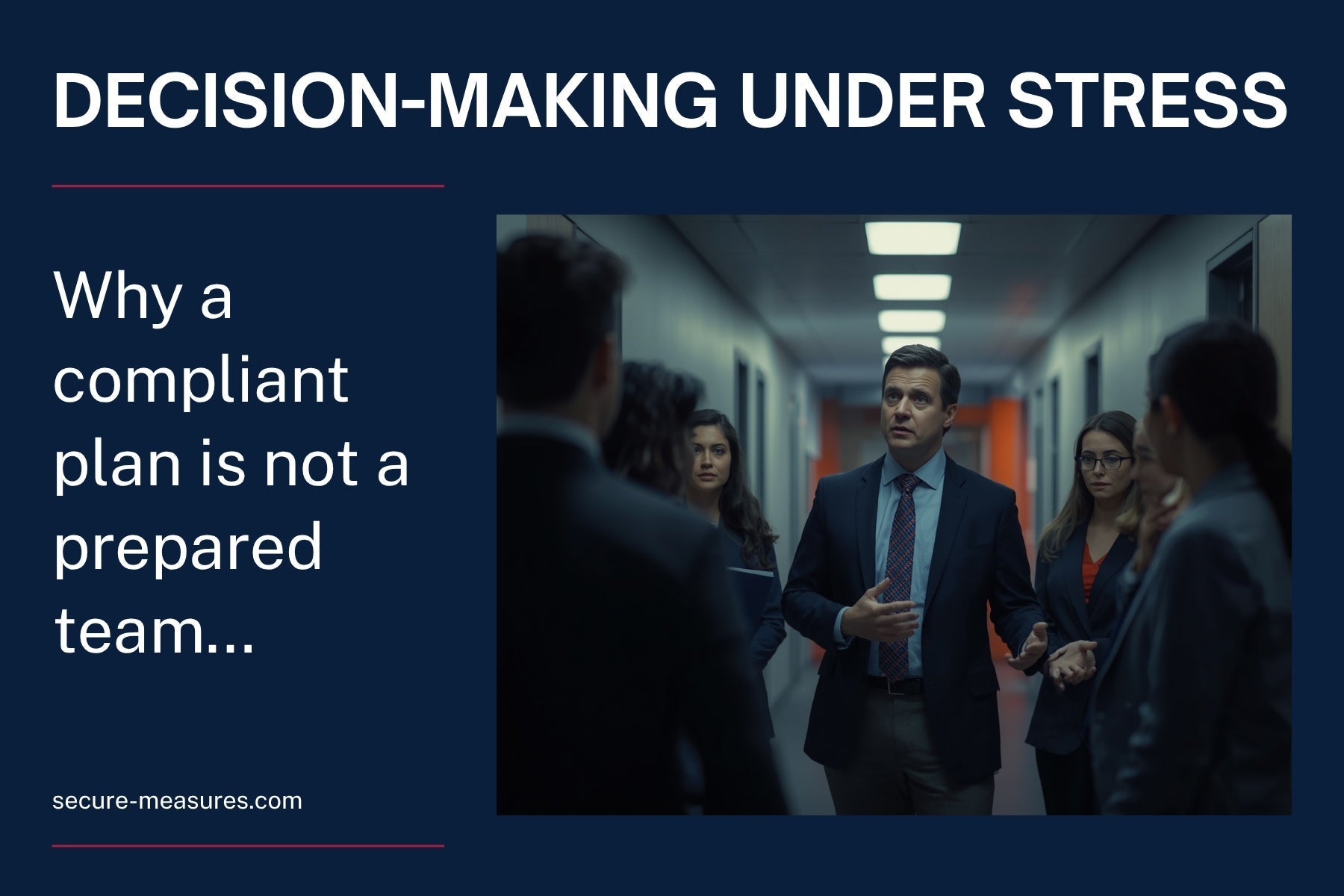
But high-stress environments don’t reward good intentions. They expose gaps in decision-making.
Escalation often occurs not because someone wanted confrontation—but because they lacked the skills to navigate complexity in real time.
De-Escalation Is a Decision-Making Discipline
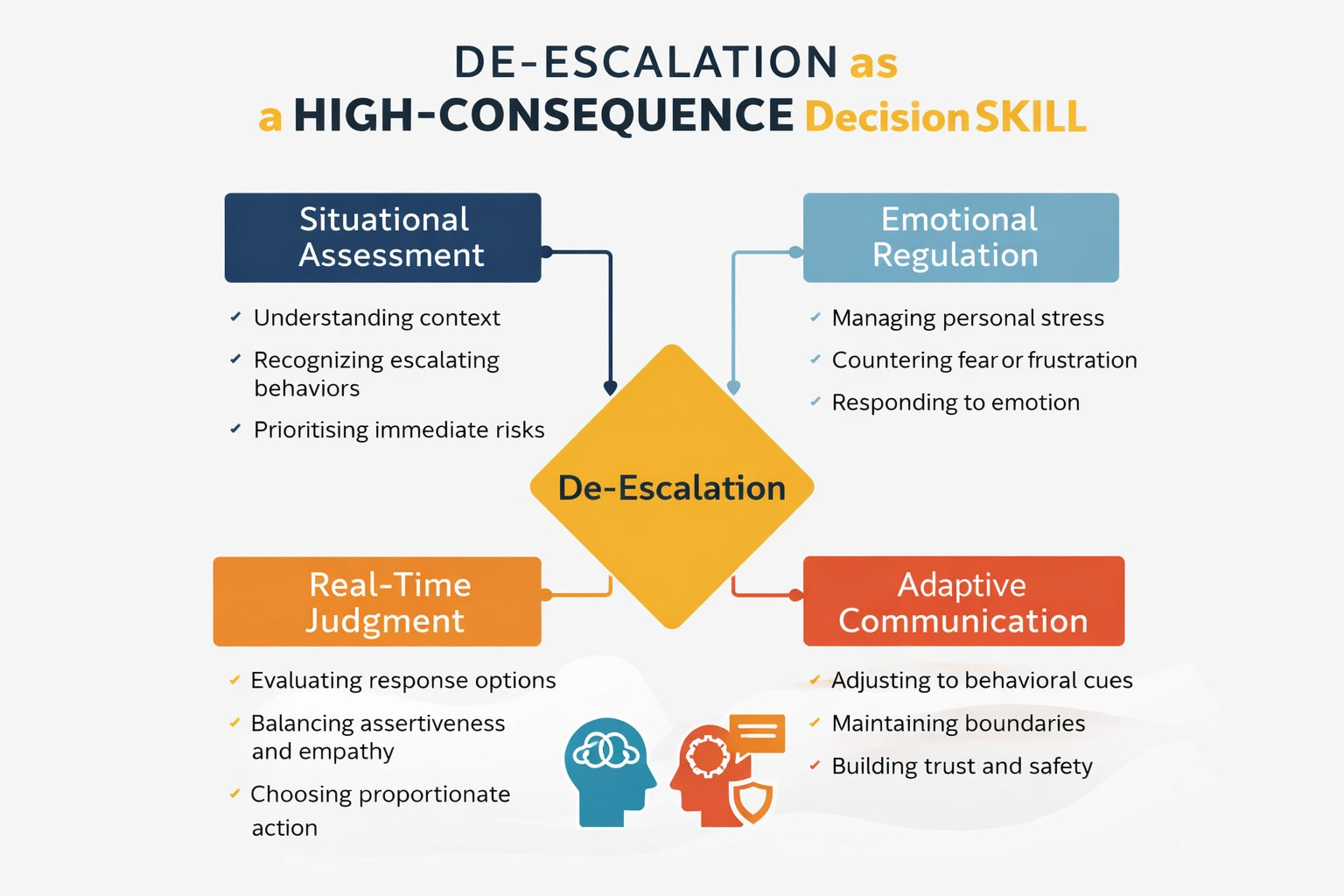
At its core, de-escalation is about choosing the least harmful path forward in a volatile moment.
That requires:
- Rapid situational assessment
- Emotional regulation
- Risk prioritization
- Judgment under uncertainty
These are not soft skills.
They are cognitive and behavioral competencies.
Just as organizations train people to make decisions about safety, security, or operations, they must train people to make decisions about human behavior under stress.
Why Information Alone Doesn’t Change Behavior
Many de-escalation programs emphasize what to do:
- Use calm language
- Maintain distance
- Listen actively
These techniques are useful—but incomplete.
They fail when:
- The other person escalates unexpectedly
- The situation becomes ambiguous
- Authority is challenged
- Fear or anger spikes
In those moments, the brain defaults to instinct—not instruction.
Effective de-escalation training must address how people think and react when emotionally activated, not just what they should say.
The Emotional Brain and Escalation
Escalation is rarely logical.
It is driven by:
- Perceived threat
- Loss of control
- Shame or humiliation
- Fear of being dismissed
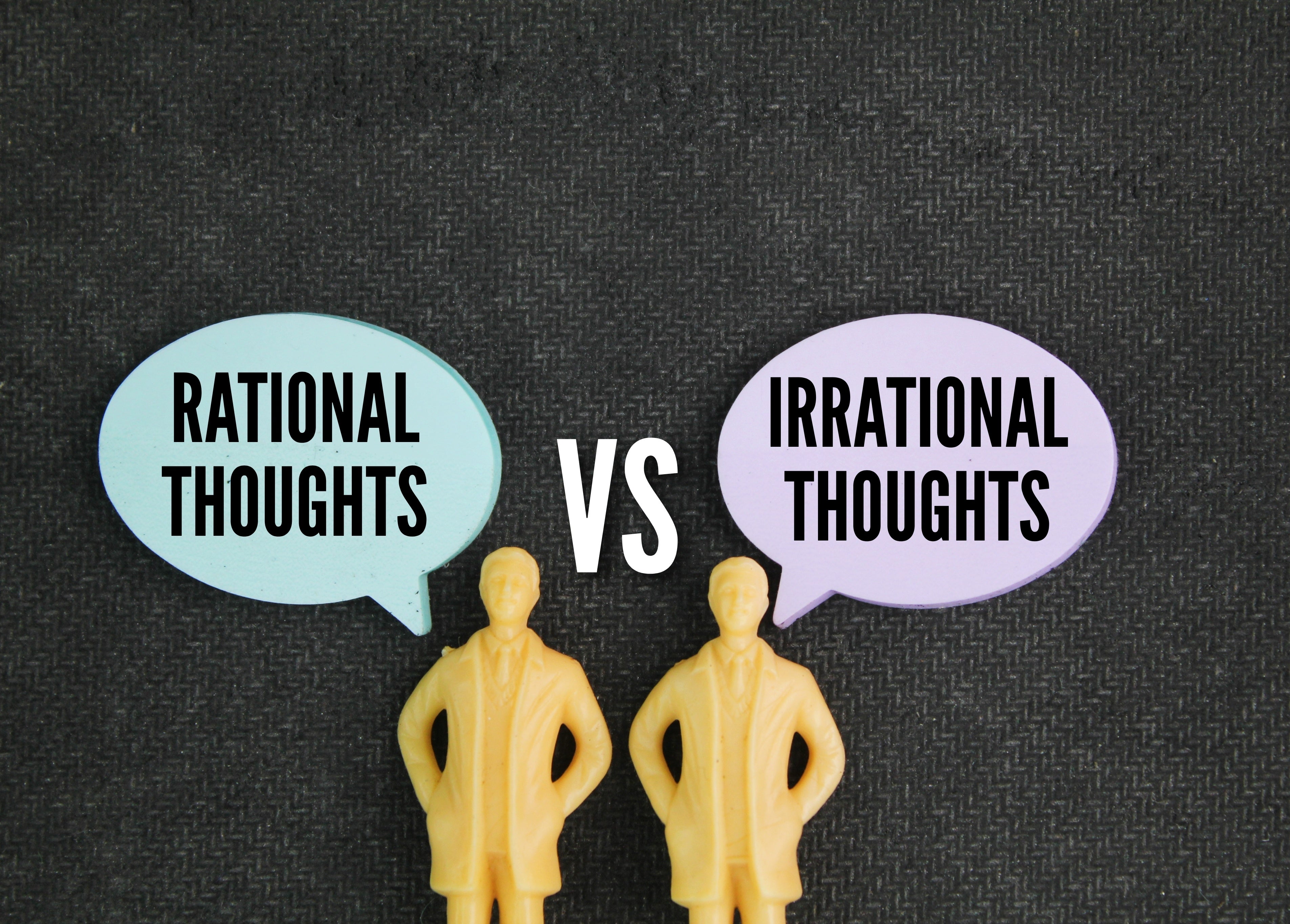
When someone enters an emotionally charged state, their capacity for reasoning narrows. Attempts to “logic them out” often backfire.
De-escalation works when responders understand:
- Emotional cues
- Behavioral shifts
- Stress responses
And adjust accordingly.
Ignoring the emotional brain doesn’t make it disappear—it makes escalation more likely.
De-Escalation Requires Situational Awareness, Not Scripts
Scripts fail when reality deviates from expectation.
De-escalation requires:
- Reading the environment
- Interpreting non-verbal behavior
- Recognizing escalation indicators
- Adjusting approach in real time
This is why scenario-based training is so effective. It exposes individuals to:
- Ambiguity
- Time pressure
- Emotional unpredictability
And forces decision-making—not memorization.
Why Escalation Is Often an Organizational Failure
Escalation is frequently blamed on individuals.
But in many cases, escalation reflects:
- Poor training design
- Lack of decision authority
- Conflicting policies
- Inadequate leadership support
When employees are unsure:
- What they are allowed to do
- When they should disengage
- Who will support their decisions
They hesitate—or overreact.
Organizations that want effective de-escalation must align policy, training, and leadership expectations.
The Role of Confidence in De-Escalation
Confidence is not bravado.
It is the quiet assurance that:
- You understand the situation
- You have options
- You are supported
Without confidence, people default to:
- Rigid enforcement
- Avoidance
- Premature escalation
Confidence is built through:
- Repetition
- Realistic practice
- Constructive feedback
Not through lectures.
De-Escalation and Proportional Response
One of the most critical de-escalation skills is proportionality.
Not every conflict requires:
- Authority
- Discipline
- Removal
Over-response often escalates tension, reinforces grievance, and damages trust.
Effective de-escalation seeks to:
- Reduce intensity
- Preserve dignity
- Maintain safety
- Create space for resolution
This requires judgment—not checklists.
Integrating De-Escalation Into Organizational Culture
De-escalation cannot exist in isolation.
It must be reinforced through:
- Leadership modeling
- Clear expectations
- After-action learning
- Psychological safety
When organizations only talk about de-escalation during training—and not during daily operations—it becomes performative.
Culture determines whether de-escalation is practiced or abandoned under pressure.
Measuring De-Escalation Success
Successful de-escalation rarely looks dramatic.
It often looks like:
- Conflict that didn’t escalate
- Complaints that didn’t multiply
- Incidents that quietly resolved
Organizations must resist the urge to measure only visible outcomes.
The true measure of de-escalation effectiveness is harm avoided, not force applied.
Closing Thought: De-Escalation Is Where Preparedness Meets Humanity
De-escalation sits at the intersection of:
- Safety
- Leadership
- Emotional intelligence
- Decision-making
It is not soft.
It is not optional.
And it is not intuitive under stress.
Organizations that treat de-escalation as a high-consequence decision making skill build safer environments—not because they avoid conflict, but because they know how to navigate it.