Knowledge Alone Does Not Create Performance

Secure Measures Insights
Knowledge Alone Does Not Create Performance
By Dave Weiner, MPsy.
Organizations invest significant time and resources in training every year. Employees attend workshops, complete online courses, earn certifications, and satisfy mandatory compliance requirements. Yet despite these investments, many leaders continue to ask the same question:
Why doesn't behavior change?
It's a fair question—and one I've reflected on throughout more than three decades in public safety, leadership, and professional training.
In my experience, the answer is surprisingly simple.
Knowledge alone does not create performance.
Knowledge is essential. It provides the foundation for good decision-making. But knowledge by itself is rarely enough to prepare someone for the complexity, uncertainty, and pressure of real-world situations. True performance is demonstrated when people must make decisions with incomplete information, communicate effectively under stress, recognize emerging risks, and apply what they've learned when the stakes are high.
That distinction has shaped every training program we develop at Secure Measures.
The Missing Link Between Learning and Performance
Early in my career, I attended many outstanding training programs. The instructors were knowledgeable, the material was well organized, and the information was valuable.
But over time I realized something was missing.
Too often, learning ended when the presentation did.
Participants listened carefully, took notes, completed an assessment, and received a certificate. Yet they were rarely given meaningful opportunities to apply what they had just learned in an environment that resembled the challenges they would actually face.
That experience fundamentally changed how I think about professional development.
Instruction without application is an incomplete learning process.
Knowledge becomes meaningful when people have opportunities to apply it, make decisions, receive feedback, reflect on their performance, and improve. Without those opportunities, even excellent instruction often remains theoretical rather than practical.
This philosophy has become one of the cornerstones of how we design training today.
Why Information Alone Rarely Changes Behavior
One of the most common reasons training fails to produce lasting behavioral change is that participants memorize information without ever being required to use it.
Knowing a policy is important.
Applying that policy during a crisis is something entirely different.
Organizations often assume that because someone understands the material, they will naturally perform well under pressure. Human performance, however, is far more complex than simple recall.
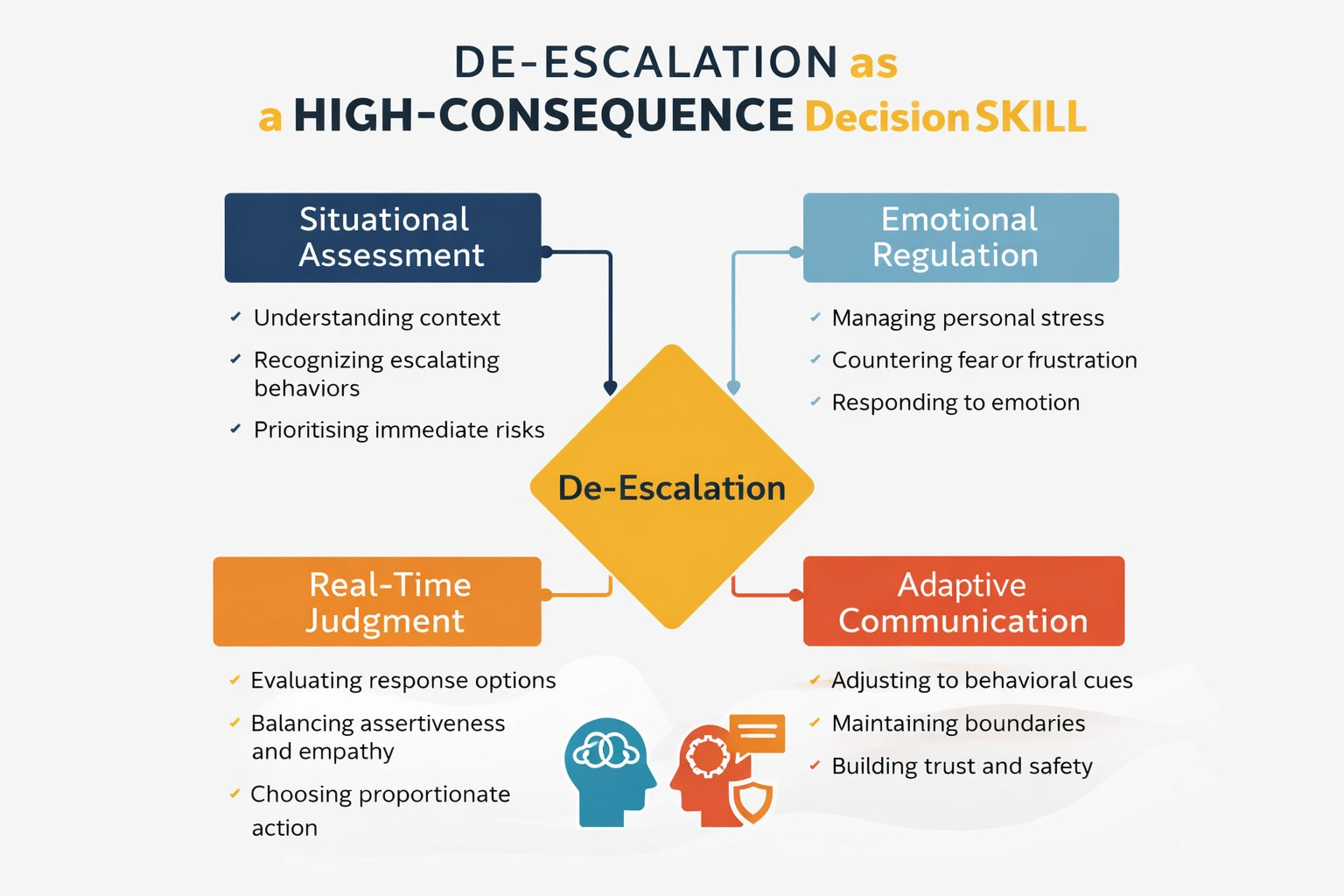
When people encounter uncertainty, rapidly changing conditions, or high-consequence situations, they must do much more than remember information. They must assess competing priorities, recognize subtle warning signs, communicate effectively, manage emotions, solve problems, and make sound decisions despite limited time and incomplete information.
Those capabilities are developed through deliberate practice—not passive exposure to information.
Educational research has consistently shown that learning becomes significantly more durable when individuals actively retrieve information, apply it in realistic contexts, receive immediate feedback, and reflect on their performance. Likewise, research on deliberate practice demonstrates that expertise is developed through structured repetition with coaching and feedback rather than through experience alone.
The objective of training should never be to simply transfer information.
It should be to improve performance.
Stress Changes the Equation
Every organization I have worked with describes its people as its greatest asset.
I agree.
People are also wonderfully complex.
One of the greatest misconceptions about training is the belief that if people know the policy, they will automatically follow it when confronted with significant adversity.
Human behavior simply doesn't work that way.
Stress changes how we think, communicate, prioritize, and make decisions. Under pressure, people often rely on familiar habits, previous experiences, emotions, and whatever they have practiced most consistently. That isn't necessarily a failure of character or commitment—it's part of being human.
Research in psychology, neuroscience, and human performance has repeatedly demonstrated that stress can narrow attention, reduce working memory, and influence judgment. While organizations cannot eliminate stress from high-consequence environments, they can better prepare people to perform effectively when stress inevitably appears.
This is precisely why realistic practice matters.
Training should allow people to think, adapt, make mistakes, receive feedback, and build confidence before they encounter situations where mistakes carry real consequences.
People should make their mistakes in training—not during the moment that matters most.
What Success Looks Like
At Secure Measures, we don't define successful training by the number of slides presented or certificates issued.
We define it by what happens after participants leave the classroom.
Our objective is not simply to increase knowledge.
Our objective is to change how people think.
We want participants to recognize risks earlier, make better decisions, communicate more effectively, and approach difficult situations with greater confidence and professionalism.
Confidence is often misunderstood.
It doesn't come from attending a class or reading a policy.
Confidence develops through preparation, realistic practice, thoughtful feedback, repetition, and reflection. It grows when people experience challenging situations in a controlled environment and learn how to respond more effectively over time.
Ultimately, we want every participant to leave believing their time was well spent because they are better prepared to fulfill the responsibilities entrusted to them.
Leadership Shapes Learning
One of the biggest misconceptions I have observed over the years isn't about training itself—it's about why organizations conduct training.
Too often, training is introduced only after something has gone wrong.
An incident occurs.
A complaint is filed.
A policy is violated.
Someone makes a mistake.
The response becomes, "Send them to training."
Corrective training certainly has its place. However, organizations should be equally committed to preparing people before problems occur.
I've also seen situations where training is perceived as punishment rather than an investment. When participants believe they are attending because they failed instead of because the organization values their development, learning becomes significantly more difficult.
Perhaps the most common challenge, however, is viewing training primarily as a compliance requirement.
Compliance is important.
But compliance should never become the finish line.
Organizations that consistently perform at a high level understand that training is far more than a regulatory obligation. It is a strategic investment in human capability.
If I could offer organizational leaders one piece of advice, it would be this:
Create a culture of performance improvement.
Leaders establish how learning is valued within an organization. When leaders actively pursue their own professional development, remain curious, seek feedback, and encourage continuous learning, they send a powerful message that growth is everyone's responsibility.
I also believe organizations should support learning opportunities beyond an individual's immediate job responsibilities whenever practical. Every meaningful educational experience has the potential to strengthen communication, leadership, critical thinking, or decision-making. Those benefits rarely remain confined to a single classroom.
Strong organizations don't simply develop employees.
They develop professionals who continue improving throughout their careers.
From Knowledge to Performance
One way I think about effective professional development is this:
Knowledge → Application → Feedback → Reflection → Judgment → Performance
Knowledge begins the process.
Application tests understanding.
Feedback identifies opportunities for improvement.
Reflection transforms experience into learning.
Judgment develops through repeated practice.
Performance is the outcome.
When organizations stop measuring training by what people know and begin measuring it by how people perform, training becomes one of the most valuable investments they can make.
Leadership Reflection
As you evaluate your organization's approach to professional development, consider these questions:
-
Do we measure attendance, or do we measure improved performance?
-
Are employees given opportunities to practice before they're expected to perform?
-
Does our training reflect the environments people will actually face?
-
Do our leaders model continuous learning and professional development?
-
Are we building a culture of compliance—or a culture of performance improvement?
The answers to those questions often reveal far more about an organization's preparedness than any training record ever will.
Final Thoughts
The purpose of training is not simply to transfer information.
It is to improve human performance.
That requires more than presentations, policies, and compliance checklists.
It requires leaders who value learning, instructors who create opportunities for realistic application, and organizations that view professional development as an ongoing investment rather than a periodic requirement.
Knowledge alone does not create performance.
Preparation does.
Practice does.
Reflection does.
And ultimately, people—not policies—determine how organizations perform when the stakes are highest.
About Secure Measures Insights
Secure Measures Insights is the thought leadership publication of Secure Measures, LLC. Drawing upon decades of operational experience and supported by evidence-informed practice, our Insights explore leadership, human performance, crisis stabilization, organizational readiness, and the development of professionals who perform effectively in high-consequence environments.