Why Most Workplace Violence Prevention Programs Fail Before the First Incident

Introduction: The Illusion of Preparedness
Most organizations believe they are prepared for workplace violence.
They have a policy.
They’ve conducted a training.
They’ve checked the compliance box.
And yet—when an incident occurs—the response is often confused, delayed, or ineffective.
This disconnect isn’t accidental. It’s structural.
Workplace violence prevention programs don’t usually fail because organizations don’t care. They fail because they are built around documentation and optics, not human behavior and decision-making under stress.
The hard truth is this:
Many programs are already broken long before the first warning sign appears.
Understanding why that happens is the first step toward building something that actually works.
Failure Point #1: Compliance Is Treated as the Finish Line
Regulations matter. Policies matter. Documentation matters.
But compliance is not prevention.
Too many workplace violence prevention programs are designed to satisfy external requirements rather than internal realities. The focus becomes:
- Was the policy written?
- Was the training delivered?
- Was attendance documented?
What gets lost is the more difficult question:
Did anything meaningfully change in how people recognize risk, intervene early, or make decisions under stress?
When compliance becomes the goal, programs tend to prioritize legal defensibility over operational effectiveness. The result is a false sense of security—one that evaporates the moment real human behavior enters the equation.
Effective prevention starts after compliance, not with it.
Failure Point #2: Policies Are Written for Lawyers, Not Humans
Most workplace violence policies are technically correct—and practically unusable.
They are:
- Dense
- Legalistic
- Abstract
- Detached from real-world behavior
Employees don’t fail to follow policy because they are negligent. They fail because the policy does not reflect how people actually think, feel, and act under stress.
If a policy cannot be recalled, understood, or applied in a moment of uncertainty, it will not guide behavior when it matters most.
Prevention requires translation:
- From policy language → behavioral expectations
- From abstract rules → situational judgment
- From documents → decision-making frameworks
Without that translation, policies sit on shelves while risk accumulates quietly in the background.
Failure Point #3: Training Focuses on Information, Not Decision-Making
Many organizations equate training with awareness.
Awareness is necessary—but it is not sufficient.
Most workplace violence training programs emphasize:
- Definitions
- Warning signs
- Reporting procedures
- Legal obligations
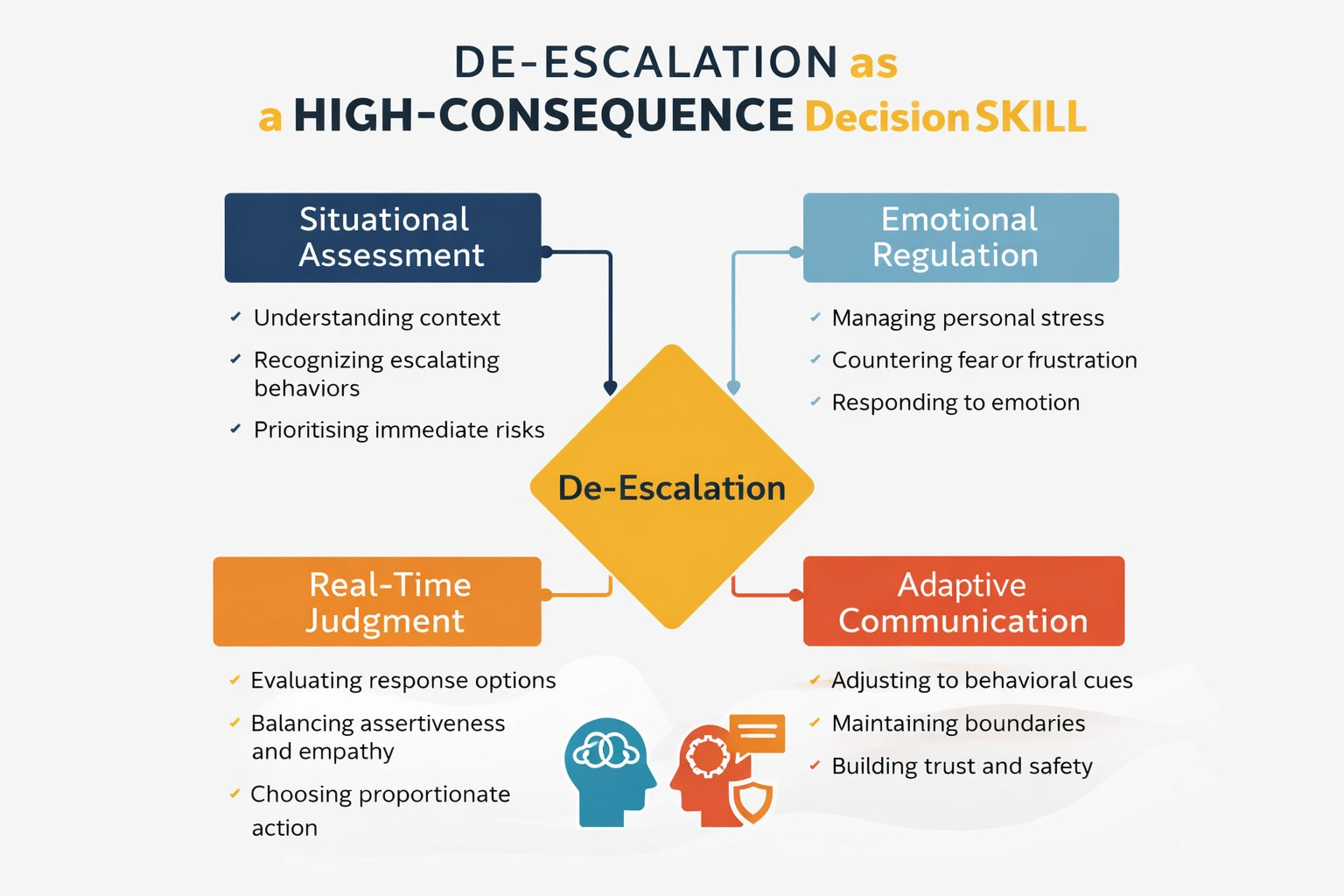
What they rarely address is what people actually do when confronted with ambiguity, emotion, fear, or time pressure.
Knowing what workplace violence is does not prepare someone to:
- Recognize escalating behavior early
- Navigate emotionally charged interactions
- Decide when to intervene, escalate, or disengage
- Act despite uncertainty
Real-world incidents don’t announce themselves clearly. They unfold gradually, often in uncomfortable gray areas.
Training that does not build judgment, confidence, and decision-making capacity leaves employees intellectually informed—and behaviorally unprepared.
Failure Point #4: Threat Assessment Is Treated as a Reaction, Not a Process
Threat assessment is often misunderstood as prediction.
In reality, effective threat assessment is about early identification, coordinated response, and risk reduction over time.
Organizations that struggle tend to:
- Activate threat assessment only after a crisis emerges
- Rely on a single department instead of a multidisciplinary team
- Treat assessment as an event rather than an ongoing process
This reactive posture leads to missed opportunities—moments where early intervention could have redirected behavior long before it became dangerous.
Prevention lives upstream.
It requires systems that notice patterns, support reporting, and respond proportionally—before a situation hardens into crisis.
Failure Point #5: Reporting Systems Don’t Feel Safe or Useful
Many programs assume that if reporting mechanisms exist, they will be used.
In reality, employees often hesitate to report concerning behavior because they fear:
- Retaliation
- Overreaction
- Being labeled as difficult or dramatic
- Nothing will change anyway
When reports disappear into a black hole—or trigger disproportionate responses—trust erodes quickly.
A prevention program cannot function if the people closest to risk do not believe:
- Reporting will be taken seriously
- Responses will be thoughtful and measured
- They will not be punished for speaking up
Psychological safety is not a “soft” concept. It is a prerequisite for early intervention.
Failure Point #6: Leadership Is Too Far Removed from the Reality of Risk
Workplace violence prevention often lives in HR, Safety, or Compliance departments.
Leadership support is expressed—but not operationalized.
When leaders are disconnected from:
- Frontline realities
- Informal warning signs
- Cultural dynamics
- Near misses and low-level incidents
Prevention becomes theoretical.
Employees take cues from leadership behavior more than policy language. If leaders treat prevention as a checkbox, that mindset permeates the organization.
Preparedness is not delegated. It is modeled.
Failure Point #7: Programs Ignore the Emotional Component of Human Behavior
Workplace violence does not emerge from logic….
It emerges from:
- Stress
- Fear
- Shame
- Perceived injustice
- Loss of control
- Emotional dysregulation
Programs that focus exclusively on procedures fail to address the emotional realities that drive behavior.
This is why escalation often surprises organizations. The signs were there—but they didn’t fit neatly into a checklist.
Prevention requires understanding how people behave when emotions override reason—and building systems that respond accordingly.
What Effective Workplace Violence Prevention Actually Looks Like
Programs that succeed share several characteristics:
1. They Treat Prevention as a Capability, Not a Document
Policies exist—but they are supported by training, leadership behavior, and operational clarity.
2. They Focus on Early, Proportional Intervention
Not every concern is a crisis. Effective programs respond in ways that reduce harm without overreacting.
3. They Build Decision-Making, Not Just Awareness
Training emphasizes judgment, confidence, and real-world application.
4. They Integrate Multiple Disciplines
HR, legal, security, mental health, and leadership work together—not in silos.
5. They Recognize That Culture Is the Real Control Measure
Culture determines whether people speak up, intervene early, and support one another.
The Cost of Failure Is Paid Long Before the Incident
When a workplace violence incident occurs, organizations often focus on the moment itself.
But the true cost accumulates much earlier:
- Missed warning signs
- Unreported concerns
- Inadequate training
- Leadership disengagement
- Cultural silence
Prevention is not about predicting violence.
It is about reducing the likelihood, severity, and impact of human crisis.
Programs fail when they are built to look good on paper instead of function under pressure.
Closing Thought: Prevention Is a Leadership Decision
Workplace violence prevention is not an HR initiative, a compliance exercise, or a one-time training.
It is a leadership decision to:
- Take human behavior seriously
- Invest in capability, not optics
- Address risk early, thoughtfully, and consistently
Organizations that make that decision don’t just reduce incidents.
They build trust, resilience, and credibility—long before a crisis ever tests them.