Would You Know the Person in Front of You Is a Veteran?
Someone in crisis will stand in front of your staff this month. If that person is a veteran, almost everything about the right response changes.
Would anyone know?
For most organizations the honest answer is no, or not in time. Identification happens by luck, usually partway through, usually after the hard part is already over. I ran a team built around this problem, and I still think it is the least funded and most consequential gap in the work.
A federal document published this month makes it harder to ignore.
On August 12, HHS, the Office of National Drug Control Policy, and HUD released a Best Practices Toolkit on homelessness and addiction, SAMHSA publication number PEP26-04-009. It came out of a national summit held April 12 through 14, 2026.
Most of it is about treatment, financing, and encampment response. But Chapter 5 describes how to staff and train specialized street outreach teams, and two lines in it should matter to anyone who serves veterans.
The first names a specialized team model:
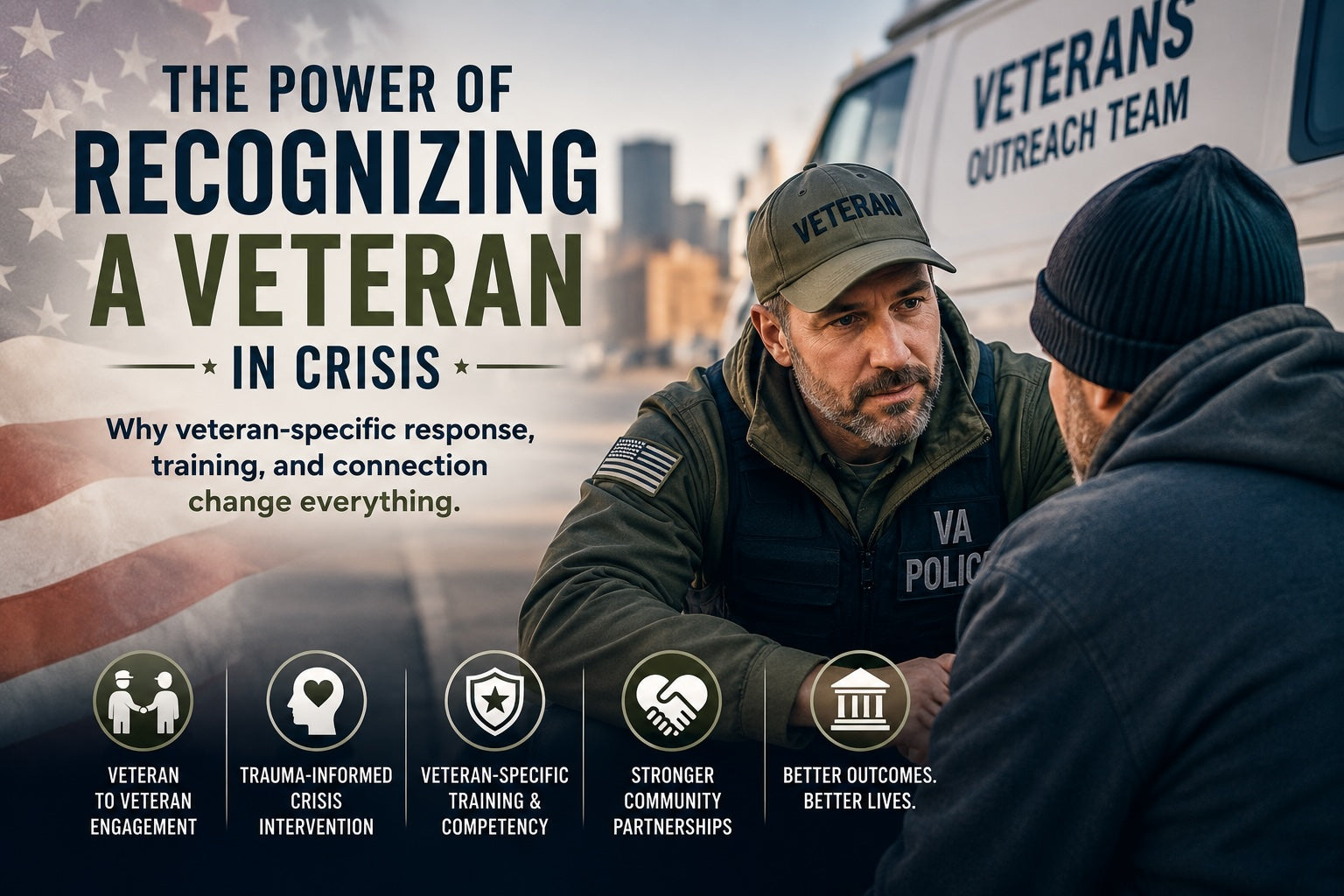
Veterans Outreach Teams: Veteran-to-veteran engagement with embedded VA clinicians and peer support.
The second is a training list. Staff on these teams, the toolkit says, are selected for experience, maturity, communication skills, and emotional intelligence, and their required training covers five areas: crisis intervention, trauma-informed engagement, motivational interviewing, autism awareness, and veteran-specific training.
A veteran-specific competency is now sitting on a federal best practices list next to crisis intervention. That is new, and it is worth paying attention to.
We built that team, and I was at the federal table when it started
This idea was borne out of a need for collaboration.
In December 2017, SAMHSA and the VA named the first cities for the Mayor's Challenge to Prevent Suicide Among Service Members, Veterans, and their Families. Los Angeles was selected, on the strength of its veteran population and its suicide rates, to build an interagency team. Eight city teams nationwide met in Washington, DC, in March 2018.
I was in that room as the representative for the VA Police Department. A lieutenant from the Los Angeles County Sheriff's Department Mental Evaluation Teams was there as the county delegate. We later co-authored the proposal that put our piece of it on paper.
So when I say a federal toolkit now describes this model, understand where I am standing. I am not an outsider reading a federal document. I sat on one of the eight teams the federal government asked to build this in the first place.
At the time I was Chief of Police for the Veterans Affairs Police Department at the VA Long Beach Health Care System. We spent the spring of 2018 assembling the program and launched it in August 2018.
The design is the one the toolkit describes. A VA police officer, nearly always a veteran, paired with a licensed clinician from VA Mental Health. When a local agency had someone in crisis who turned out to be a veteran, they called us and we rolled.
Two sets of numbers, and they measure different things.
The case for building it came from our own call volume. The VA Police Long Beach office responded to 178 calls for service involving veterans in mental health crisis in FY16, and 290 in FY17. Those were our calls, around our own facility, before any co-response team existed. The trend line was the argument.
What the team then did is the second number. We took roughly 70 co-response calls at the request of partner agencies across Los Angeles County. Every one of them resolved peacefully, and the veteran went to a VA mental health facility rather than a jail cell. During the pilot phase early that year, across the whole county partnership, neither the Sheriff's crisis deputies nor our officers used force during a single detention.
One caveat, and I would rather say it than have someone else find it. This was the beginning of the program, and our data collection then was not what it would be today. Treat these as the honest shape of what happened, not as audited figures. Building the counting is part of building the team, and it is a part we were still learning.
Eight years on, a federal toolkit describes the same structure and calls it a best practice.
Why veteran-to-veteran is doing real work, not sentiment
Nearly every officer in the VA Police Department is a veteran. Across most local law enforcement crisis teams, only a fraction are.
That gap is the whole reason the model exists. A veteran in crisis is reading the person in front of them for whether they have any idea what they are talking about. That read happens fast and it is not generous. Shared service is not rapport by itself, but it opens a door that nothing else opens, and it opens it quickly, which is the only kind of quick that matters when someone is in the middle of the worst hour of their year.
Our officers also worked inside the VA every day. They knew the clinicians by name. When they told a veteran what was going to happen at the hospital, they were describing a place they had walked through that morning.
Two examples from that period, generalized. The people in them agreed to talk to us about their own care.
In the first, a local agency had already taken a woman veteran into custody during a mental health crisis. Nobody had used force and she was safe, but once she was in the car she would not move, and the options left on scene all pointed toward force. Our team responded and the officer who talked with her was a veteran. She agreed to go. She was admitted to VA care that night, and nobody put hands on her. What she said afterward was that veterans understand veteran issues, and that the local department could stand to have a few veterans on its own force.
In the second, every responder on scene was in uniform. The veteran told us afterward that he was frightened the entire time, that the questions came fast, and that nobody tried to learn anything about him. He settled only after our officers arrived and spoke with him as veterans. His advice for next time was simple: spend more time talking and finding out about me. That call also ended in transport to VA care, with no new charges and no force used.
Neither of those responders did anything wrong. Both worked with a checklist. One of them worked with the Veteran.
One more thing if you operate in California. Section 5153 of the Welfare and Institutions Code requires plain clothes and unmarked vehicles for this work. That is not a style preference, and the second example is exactly what the requirement exists to prevent.
The part nobody budgets for: knowing the person is a veteran
The toolkit's five-step encampment framework puts identification first and assessment second, and it names veterans among the vulnerable populations that assessment should surface.
That sounds procedural. It is the hardest part.
The most useful thing we built was not the team. It was a checkbox. Working with the Sheriff's Department, we got a veteran flag added to their crisis team dispatch system. When it was checked, it notified our on-call lieutenant, who decided with me whether to send a unit.
Before that, a veteran in crisis in this county was just a person in crisis. Identification happened by luck, usually partway through the call, usually after the hard part was over.
If your intake does not ask, you do not know. If you do not know, none of the specialized response the toolkit describes is available to you, no matter how good your team is.
Warm handoffs, and the system veterans already have
The toolkit builds a whole chapter around warm handoffs and a "no wrong door" approach, and it is right to. It lists law enforcement, crisis stabilization teams, and street outreach among the entry points that should connect to care rather than dead-end.
Veterans have something the general population does not, which is a parallel federal system with its own hospitals, clinicians, and benefits. That is an advantage only if somebody knows how to open the door. A phone number is not a handoff. A named person is.
Where I land on Housing First
The toolkit cites a large-scale study finding that veterans in supported housing were consistently more likely to die from drug overdose than homeless veterans. The document builds a policy argument on top of that. I will give you my own, because I say this in every class I teach and it belongs here too.
I am not of the opinion that Housing First is always the best model. It has flaws, and the most important one is not the housing itself.
Housing First would be great if all of the associated wraparound services were done concurrently. Treatment, mental health care, case management, peer support, all of it starting when the keys change hands rather than queued behind them. Delivered that way, the model does what it claims.
They are not always done that way. The housing gets funded and filled, the services arrive late, partially, or not at all, and then the model gets judged on results it was never resourced to produce. That is why it does not seem to me to be the best model.
So I am not here to tell you to abandon a housing model. I am here to tell you that whichever model you run, somebody on your staff has to be able to recognize a veteran in crisis and know exactly where to hand them. That is true under Housing First, under Treatment First, and under whatever the next label turns out to be.
This is fundable, and most people miss that
The toolkit's financing chapter lists the federal programs behind this work. Four are worth knowing if you serve veterans:
- Staff Sergeant Parker Gordon Fox Suicide Prevention Grant Program. Funds outreach to identify at-risk veterans, and education on suicide risk and prevention for families and communities. Training is an eligible activity, not an afterthought.
- Supportive Services for Veteran Families (SSVF). Centers on housing with supportive services, crisis response, veteran choice, and progressive assistance.
- Grant and Per Diem (GPD) and Health Care for Homeless Veterans (HCHV). Both fund community-based organizations directly.
If you have been treating veteran crisis training as a nice-to-have that never survives the budget, the funding line exists. It is named in a federal document you can cite in the request.
What to do with this
Four things, none of which need a new team.
- Add the service question to your intake and train your people to handle the answer. This is the cheapest and highest-return change available.
- Look at the toolkit's five training areas and see which ones your frontline staff have actually had. Not been assigned. Had.
- Build the veteran referral list before you need it, and put a real person's name on every line of it.
- If you are writing a grant request this fall, cite the toolkit by publication number. Details at the bottom of this post.
The toolkit is a good document and it is worth reading in full. It is also, for once, a federal publication that says out loud what those of us who have run these teams have been saying for the better part of a decade. Veterans are a distinct population in crisis, and the people who respond to them should be trained for it.
If you want help building that training, that is what we do. Secure Measures delivers veteran cultural competency and crisis response training to county departments, veteran services organizations, and employers.
Get the toolkit
Substance Abuse and Mental Health Services Administration. Best Practices Toolkit: Addressing Homelessness and Addiction through "Treatment First." SAMHSA Publication No. PEP26-04-009. Released August 2026.
Download it free: https://www.whitehouse.gov/wp-content/uploads/2026/08/Best-Practices-Toolkit_FINAL.pdf
The toolkit's own acknowledgements page also directs readers to SAMHSA's library at library.samhsa.gov, where it can be found by publication number.
It is worth reading in full, and it is in the public domain. You can quote it, excerpt it, hand it to your board, and attach it to a funding request without asking anyone's permission. The only restriction is that you cannot sell it.
The sections referenced above are Chapter 3 on warm handoffs, Chapter 4 on financing, and Chapter 5 on the community response model and specialized teams.
If you or a veteran you know is in crisis, the Veterans Crisis Line is available 24 hours a day, every day. Dial 988 and press 1, text 838255, or chat at veteranscrisisline.net. You do not need to be enrolled in VA care.