Decision-Making Under Stress: What California's Coming Workplace Violence Standard Will Actually Test
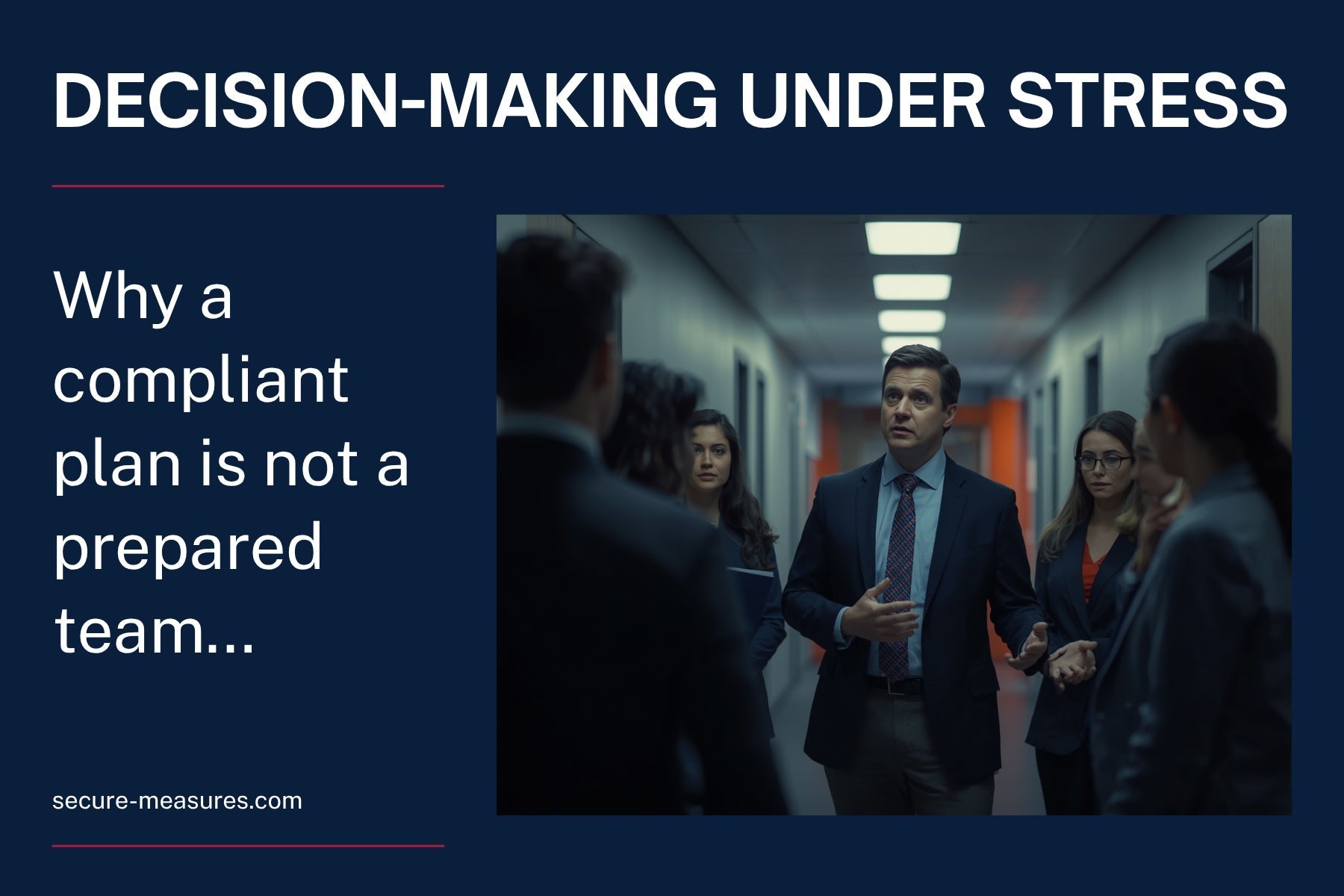
A written workplace violence prevention plan proves you complied. It does not prove your people can perform. Those are two different things, and California is about to make the gap between them a great deal more visible.
Under Labor Code section 6401.9, created by Senate Bill 553, nearly every California employer has been required to keep a Workplace Violence Prevention Plan since July 1, 2024. Most organizations we work with have one. Fewer have tested whether their staff can execute it while their heart rate is at 160.
What changes between now and December 31, 2026
Cal/OSHA is currently developing a permanent workplace violence prevention standard for general industry, the non health care sector. The Occupational Safety and Health Standards Board is required to adopt that standard no later than December 31, 2026. The most recent revised draft was published on July 22, 2026, and the Division set August 17, 2026 as the deadline for written comment.
If you employ people in California and you have not read that draft, this is the week to do it. Comment closes in days, and the standard that follows will govern how your plan is written, trained, and inspected.
Here is the part worth sitting with. The law already requires your plan to include procedures on how to respond to actual or potential workplace violence. Responding is not a document. It is a set of decisions made by a frightened person in the first ninety seconds. Compliance asks whether the procedure exists. An incident asks whether anyone can reach it.
What stress actually does to your people
The physical response to a sudden threat is not subtle, and it is not optional. It happens to trained professionals as reliably as it happens to everyone else.
Heart rate climbs fast. Vision narrows toward the center, so peripheral detail drops out. This is why staff involved in a violent incident often cannot describe what was happening off to the side, even when it mattered. Hearing compresses, and people report that a shouted instruction sounded far away or that they never heard it at all. Fine motor control degrades, so tasks that need precise hand movement get harder at exactly the moment they become urgent. Keys, phone screens, and door latches all become problems.
The part that matters most for leaders is what happens to thinking. Complex reasoning gets expensive under stress. Working memory shrinks. The mind stops searching for the best available option and starts reaching for whatever is closest to hand.
None of that is a character flaw. It is physiology. Planning around it is the job.
Why people default to habit instead of policy
Under load, the brain does not select the correct action. It grabs the most practiced one.
That single sentence explains most of what goes wrong. The question is never whether your people know the right response. It is whether the right response is the one they have rehearsed most often. If your staff have practiced a lockdown procedure twice in three years, and practiced their ordinary daily workflow ten thousand times, the ordinary workflow wins. Every time.
This is the mechanism behind the old line about people not rising to the occasion but falling to their level of training. It is not a motivational poster. It is an accurate description of how decision-making degrades when conditions get hard.
Why the annual briefing does not survive contact
A classroom session transfers information, and information is useful. Staff need to know the policy, the legal duty, the warning behaviors, and their reporting obligations. We teach all of it.
But information sits in the part of the system that stress takes offline first. A person can pass a written de-escalation test in the morning and freeze in a hallway that afternoon. The knowledge did not disappear. It became unreachable.
The failure mode is predictable, and it is a measurement problem. Most organizations judge training by attendance and comprehension. Both are easy to count. Neither predicts performance under pressure. If your only evidence that a team is prepared is a completed sign-in roster, you have measured compliance, not capability.
The four types tell you who needs practice
Cal/OSHA classifies workplace violence into four types, and each one puts a different person in the room at the moment of decision.

Type 1 is committed by someone with no legitimate business at the worksite, such as a robbery. Type 2 is directed at employees by customers, clients, patients, students, inmates, or visitors. Type 3 is committed by a current or former employee, supervisor, or manager. Type 4 is committed by someone who does not work there but has a personal relationship with an employee.
Read that list against your staffing. Type 2 is the daily reality for social services, health care, public counters, schools, and housing programs. It is also the type most likely to be absorbed by a frontline employee alone, with no supervisor present, in a moment nobody logged as an incident. Employers must keep violent incident logs for a minimum of five years, which means the pattern is visible if anyone reads it. Most of the gaps we find are in Type 2 exposure held by the lowest paid people in the building.
How to test instead of only train
Scenario-based training works on a different part of the problem. The goal is not to teach the answer again. It is to make the correct response the most practiced one available, so it is still reachable when reasoning gets expensive.
At Secure Measures we run this on the MILO Range simulator and, for injury response, the AUFIRE platform. People stand up, decide in real time under time pressure, and see what their choices produced. Then they do it again.
The value is not the technology. The value is that a person has now made that decision under something close to real conditions, more than once, and has felt what a wrong read costs. That is a different kind of memory than having heard about it.
Three things come out of this work consistently. People discover their own stress response before it matters. Teams find the distance between what the plan says and what they actually do. And leaders see who communicates well under pressure, which is rarely who they expected.
There is also a compliance dividend, and it is worth claiming. Your plan has to include procedures for reviewing and revising itself, and for investigating what happened after an incident. A recorded exercise gives you both without waiting for a real event. You get a dated record of what your people actually did, the gaps you found, and what you changed as a result. That is a stronger answer to an inspector than a stack of signed rosters, and it is a far stronger answer to a jury.
One more skill is worth naming, because it is the least dramatic and the most useful. When the situation allows it, buy time. Distance, position, and patience all create room, and room creates better decisions. Most incidents that ended badly were compressed by someone who did not have to compress them. Slowing down is not passivity. It protects the conditions in which your people can still think.
Four questions to ask any training provider
Including us.
- What will my people physically do during this session, and how many times will they do it?
- How does this account for the way stress degrades performance?
- What does the debrief look like, and who runs it?
- What will I be able to observe about my team afterward that I cannot observe today?
If every answer is about content coverage, the session will produce informed people. That may be exactly what you need this quarter. Just do not record it as readiness.
Frequently asked questions
Does California require workplace violence prevention training? Yes. Labor Code section 6401.9, created by Senate Bill 553, has been in effect and enforceable since July 1, 2024. Employers must have a Workplace Violence Prevention Plan that includes procedures to communicate and provide training to employees on workplace violence.
When does Cal/OSHA's permanent workplace violence standard take effect? Cal/OSHA is developing a standard for general industry, the non health care sector. The Occupational Safety and Health Standards Board is required to adopt it no later than December 31, 2026. A revised draft was published on July 22, 2026, with written comment due by August 17, 2026.
What are the four types of workplace violence? Type 1 involves someone with no legitimate business at the worksite. Type 2 is directed at employees by customers, clients, patients, students, inmates, or visitors. Type 3 comes from a current or former employee, supervisor, or manager. Type 4 comes from someone with a personal relationship to an employee.
How long must a violent incident log be kept in California? Employers must maintain violent incident logs for a minimum of five years.
Why does workplace violence training fail during a real incident? Because stress narrows vision, compresses hearing, degrades fine motor control, and shrinks working memory. Under that load people reach for their most practiced action rather than the correct one. Training that only transfers information is stored in the part of the system stress disables first.
About Secure Measures
Secure Measures, LLC is a California based, veteran owned, Disabled Veteran Business Enterprise certified training firm, founded in 2019. We deliver workplace violence prevention, de-escalation, crisis intervention, active threat response, behavioral threat assessment and management, veteran cultural competency, and scenario-based simulation training on the MILO Range and AUFIRE platforms. We work with public agencies, nonprofits, and private employers across California and beyond.
Dave Weiner, MPsy, is CEO of Secure Measures. He is a United States Air Force veteran and a retired Chief of Police. Before retiring from law enforcement he built and ran a Veteran Mobile Evaluation Team, a crisis response unit created specifically for veterans.
Bring decision-making and crisis leadership training to your organization. Sessions run in person and live online, at two, four, or eight hours. Book a conversation.