De-escalation Training That Actually Changes Behavior: What Realistic Practice Requires
Every HR director we talk to has sat through a de-escalation slide deck. Most of them can recite the acronym from the last one. Few of them feel confident their staff would actually use it during a real confrontation. That gap between knowing the steps and doing them under stress is the real problem, and it is why classroom only de-escalation training rarely holds up.
Knowing the steps is not the same as using them
De-escalation techniques are simple to explain: lower your voice, create space, acknowledge the person's feelings, offer a choice. They are hard to execute when your heart rate is up and someone is yelling three feet from your face. Training that stops at explanation leaves staff with knowledge they cannot access in the moment that matters.
This is not a criticism of the staff. It is basic physiology. Under acute stress, the part of the brain responsible for calm, deliberate reasoning becomes harder to access, while the part responsible for fast, automatic reactions takes over. Whatever a person has genuinely practiced, meaning repeated under some degree of realistic pressure, is what tends to surface in that state. Whatever they only read or heard once tends to disappear exactly when it is needed. That is the entire argument for why de-escalation has to be trained as a skill, not delivered as a lecture.
What changes behavior instead
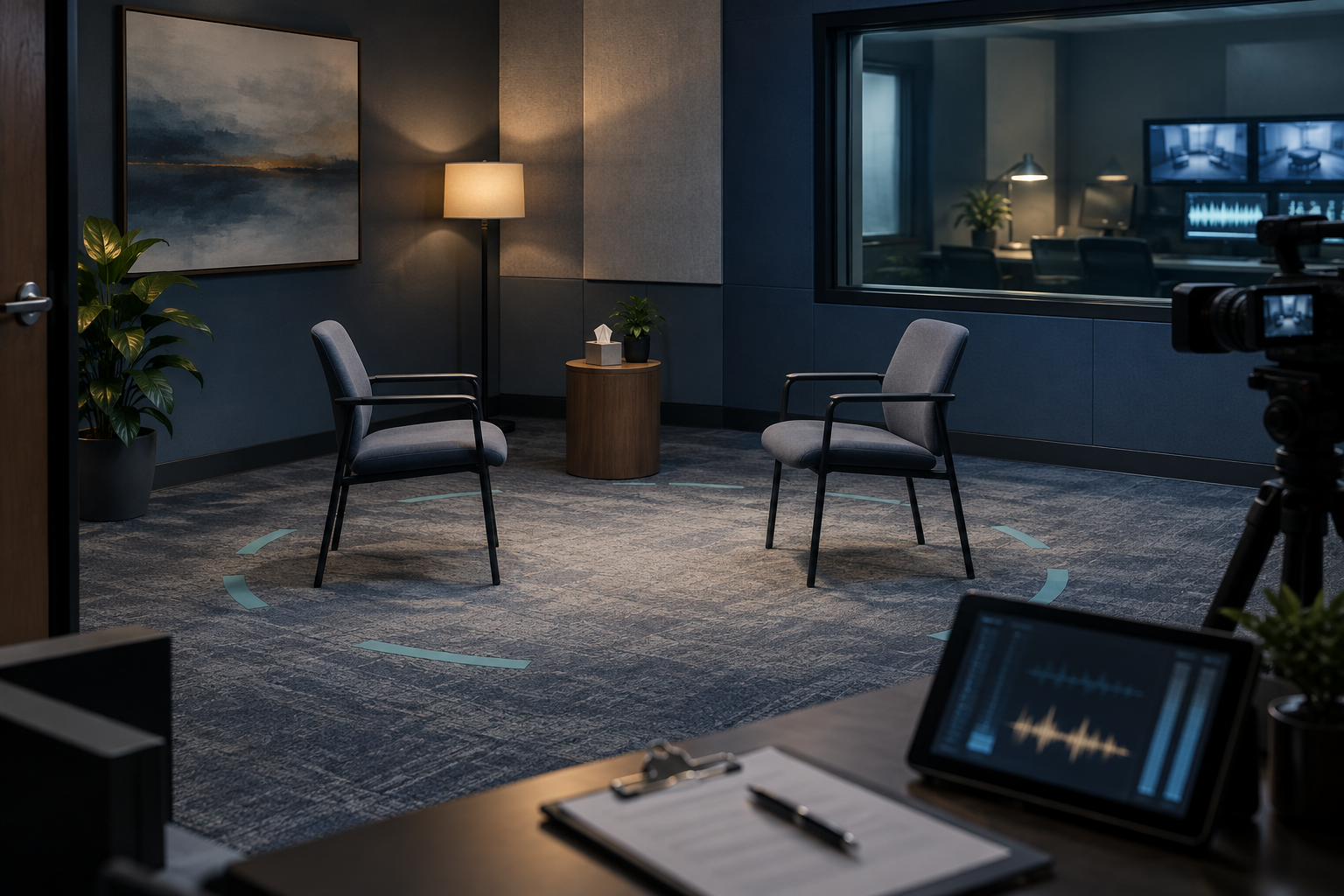
Behavior changes through repetition under realistic pressure, not through a single memorable slide. We build our de-escalation training around simulation, using MILO Range to put staff into branching scenarios where their choices change how the situation unfolds. A person who has practiced staying calm while a simulated scenario escalates responds differently the first time it happens for real.
The branching structure matters here. A scenario that plays out the same way regardless of what the trainee does teaches nothing beyond the first pass. A branching scenario, where a poor word choice or a rushed tone visibly makes the simulated person more agitated, gives staff something a lecture cannot: a direct, felt consequence for the choices they make in the moment. That consequence is what builds judgment, not just recall.
Four things separate training that sticks from training that does not:
- Scenarios drawn from situations your staff actually encounter, not generic stock examples. A retail return dispute trains differently than a hospital waiting room confrontation, and staff know the difference immediately.
- Immediate feedback on decisions, so staff see the consequence of a choice inside the training instead of only in the field. Feedback delayed to a debrief days later loses most of its power to change behavior.
- Repetition across multiple sessions, since one exposure builds awareness, not muscle memory. A single session is a demonstration. Three or four sessions spaced over months is training.
- A debrief that connects what happened in the scenario back to your organization's actual policies and escalation path, so the skill and the procedure reinforce each other rather than living in separate parts of a staff member's memory.
What good de-escalation actually sounds like
Staff often expect de-escalation to mean staying silent and absorbing whatever is said. It does not. Effective de-escalation is active: naming what you observe, without judgment, and checking your read against the person's reaction. A calm acknowledgment that the situation has been frustrating does real work, not because it is magic language, but because it signals that the staff member is paying attention rather than reciting a script. The tone and timing matter as much as the words. Said too fast, or too early, the same sentence reads as dismissive rather than attentive.
Giving a real choice matters just as much. Asking whether someone would like to sit down while things get sorted out, or would rather stand where they are, respects the other person's sense of control, which is often what has been lost in the interaction that triggered the tension in the first place. Manufactured choices, where both options actually lead to the same outcome, tend to be noticed and resented. The choice has to be genuine.
Who benefits most
Front-line staff who deal with the public directly get the clearest return: retail and hospitality teams, front desk and intake staff, and case workers in public-facing roles. But the same approach works for supervisors who need to de-escalate conflict between employees, not just conflict with the public. Internal conflict between coworkers follows a similar emotional pattern to external conflict, and the same core skills, staying regulated, acknowledging before problem-solving, offering real choices, transfer directly.
What this is not
De-escalation training is not a substitute for a workplace violence prevention plan, and it will not stop every incident. Some situations are past the point where de-escalation alone resolves them, and staff need to know when to disengage and escalate to a trained responder rather than continuing to try. Training that only teaches de-escalation without also teaching its limits sets staff up to stay in a situation longer than they should.
What good training does is reduce how often a tense situation turns into an unsafe one, and give staff something to fall back on besides instinct. Instinct under stress is unreliable precisely because it was not built for this specific situation. Trained response, even imperfectly executed, tends to outperform pure instinct.
Building this into an existing training calendar
Organizations that get the most value from de-escalation training treat it as a recurring line item, not a one-time initiative. A reasonable starting cadence is an initial session for all public-facing staff, a refresher roughly twice a year for the highest-contact roles, and a short scenario run any time a near-miss incident gets reported, so the lesson from that specific event gets reinforced while it is still fresh rather than folded into next year's general session.
If your current de-escalation training is a one-time session with no practice built in, that is worth revisiting. We run scenario-based de-escalation training designed around your actual environment, not a generic script. Reach out if you want to see what a session looks like.